Columbia University
September 2025 – May 2029
B.A. in Computer Science and Applied Mathematics
姜惠康
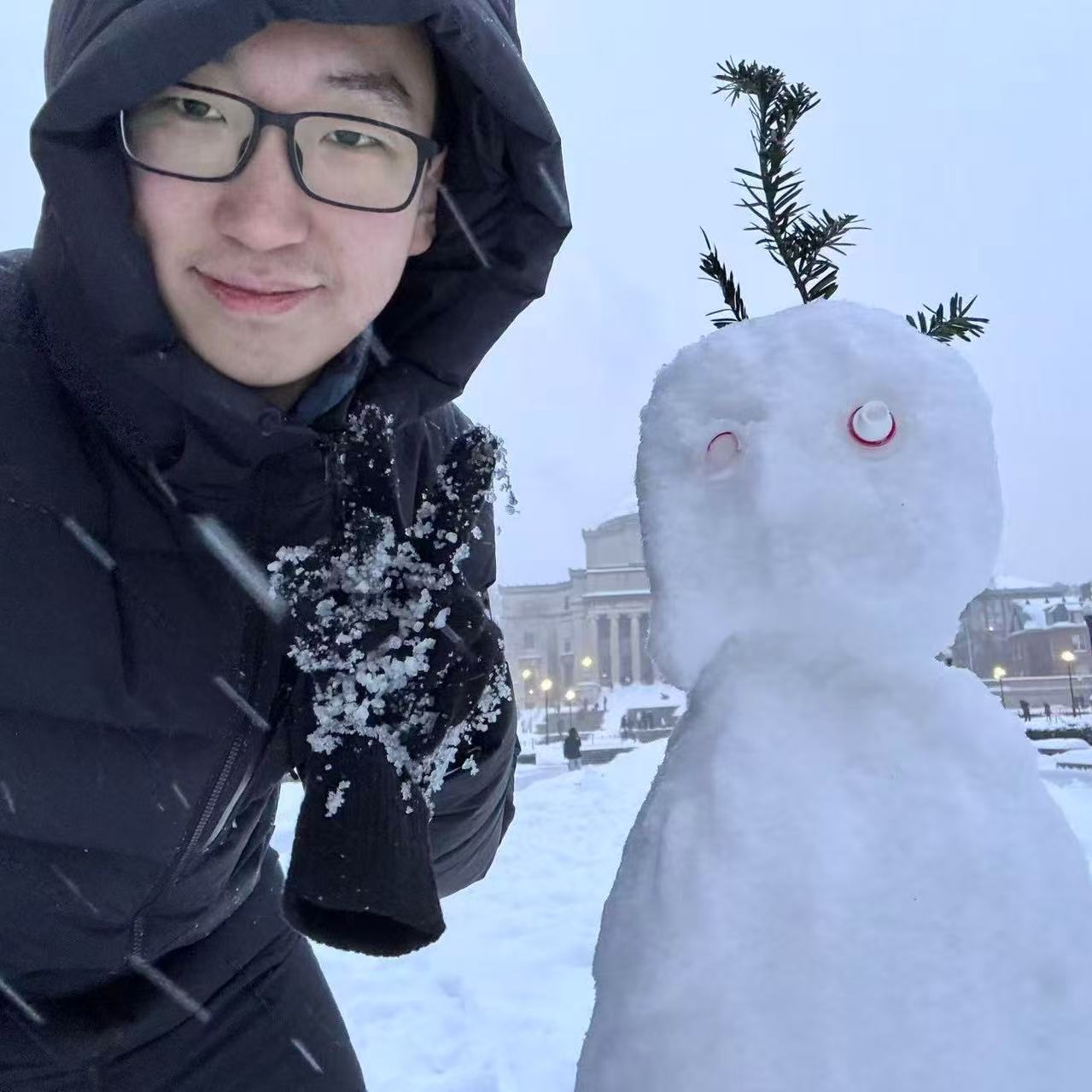
I am a sophomore at Columbia University, working on mechanistic interpretability and agentic systems for software engineering. I am particularly interested in representation analysis and agent output verification. I aim to better observe and understand large language models and integrate interpretability methods into agentic systems.
You can reach me at hj2742 [at] columbia.edu.
September 2025 – May 2029
B.A. in Computer Science and Applied Mathematics
September 2021 – May 2025
High School
September 2025 – Present
Advised by Professor Baishakhi Ray and Professor Simin Chen.
AI-driven Software Engineering. Trustworthy Coding Agents, Monitoring and Verification Systems, Agent Training.
January 2026 – May 2026
Advised by Professor Sharon Di.
LLM post-training. Enhancing LLM-human behavioral consistency for social science research.
May 2026 – Present
Advised by Professor Liangming Pan.
Mechanistic Interpretability. Representation Analysis and Engineering, Natural Language Autoencoders, and SAEs.
September 2026 – Present
A startup based at Columbia, enterprise-scale software engineering agents with policy inference and formal verification.
Under review at ICLR 2027 PDF
Construct LLM-derived semantic graphs linking issue subtasks to code-chunk diffs and classify them (via GNNs or manually extracted features) to flag injected instructions that hijack SWE agents into producing vulnerable patches.
Keywords: Agents for Software Engineering, Prompt Injection, Model Hijack, Graph Neural Networks
Under review at ICLR 2027 arXiv
Develop a comprehensive evaluation framework for representation engineering that compares methods across effectiveness, side effects, robustness, generalization, and data efficiency over a range of intervention methods.
Keywords: Representation Engineering, Activation Steering, Side Effects
November 2025 – October 2026
Designed contest questions and sample exams.
January 2026 – August 2026
Designed and validated contest questions and sample exams.
Java, Python, PyTorch